An itchy, red, or irritated patch of skin can have many possible causes. Two common possibilities are a skin allergy and a skin infection. Because both can cause redness, itching, swelling and changes in the appearance of the skin, it is not always easy to tell them apart by looking at the rash alone.
The distinction matters because the appropriate treatment depends on the underlying cause. A skin allergy may require identifying and avoiding a trigger, while a bacterial, fungal or viral skin infection may require a completely different approach.
In some cases, the two problems can even occur together. For example, repeated scratching of an itchy allergic rash can damage the skin and make it easier for an infection to develop.
So, how can you distinguish a skin allergy from a skin infection, and when should you see a dermatologist?
Skin Allergy vs. Skin Infection: What’s the Difference?
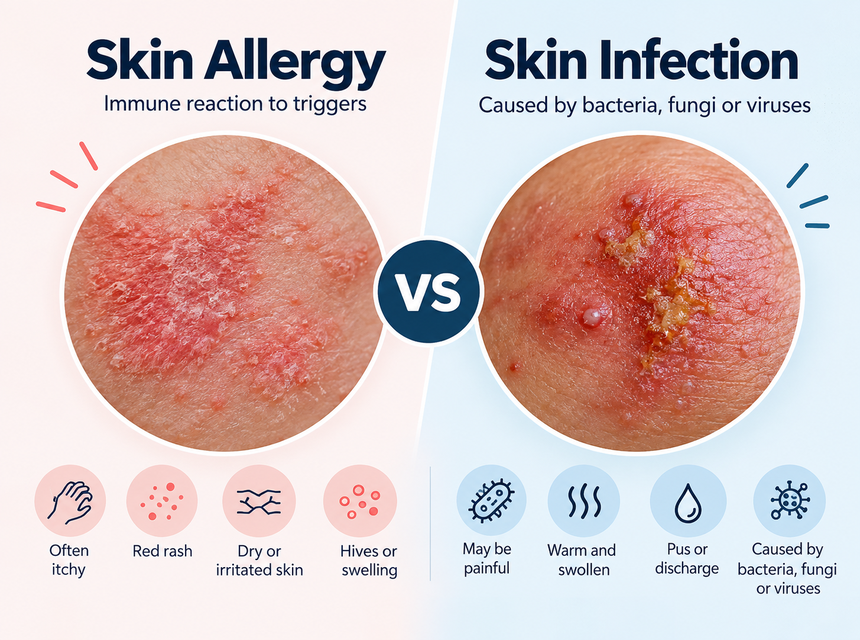
A skin allergy occurs when the immune system reacts to a substance that it considers a trigger or allergen. Depending on the type of reaction, this can cause itching, redness, swelling, hives, or an irritated rash. Contact dermatitis, for example, can occur after the skin comes into contact with certain cosmetics, fragrances, metals, plants, or other substances.
A skin infection, on the other hand, occurs when microorganisms such as bacteria, fungi, or viruses infect the skin. Different infections produce different patterns. For example, cellulitis can cause painful, hot and swollen skin, while ringworm is a fungal infection that commonly causes an itchy, scaly, ring-shaped rash.
The important point is that there is no single symptom that always proves whether a rash is an allergy or an infection.
| Feature | Skin allergy | Skin infection |
|---|---|---|
| Main cause | Immune reaction to an allergen or irritant | Bacteria, fungi or viruses |
| Itching | Often prominent | Can occur, depending on the infection |
| Redness/rash | Common | Common |
| Pain | May occur but is not always prominent | Can be prominent in some infections |
| Warmth | Less characteristic | Can occur, particularly with some bacterial infections |
| Pus/discharge | Not typical | May occur |
| Fever | Usually not a feature of a simple allergic rash | Can occur with some infections |
| Contagious | Generally not | Some infections can spread to others |
These are general patterns, not a diagnostic checklist.
What Does a Skin Allergy Usually Look and Feel Like?
Skin allergies can produce several different types of rash. The symptoms depend on the type of allergic reaction and the part of the body affected.
Common skin allergy symptoms may include:
- Intense itching
- Red or discolored skin
- Swelling
- Dry or cracked skin
- Burning or stinging
- Small bumps
- Blisters
- Oozing or crusting in some forms of dermatitis
- Raised, itchy welts known as hives
Contact dermatitis is one common example. It can develop after contact with substances such as cosmetics, fragrances, soaps, detergents, hair products, jewelry or certain plants. The rash may occur mainly where the triggering substance touched the skin.
Hives, or urticaria, are another type of skin reaction. They typically produce raised, itchy welts that can change shape and appear in different areas of the body. Individual hives often disappear within 24 hours, although new ones may develop.
If you are experiencing persistent itching, recurrent rashes or suspected allergic skin reactions, you can learn more about [skin allergy treatment in Sylhet] and when professional evaluation may be appropriate.
What Does a Skin Infection Usually Look and Feel Like?
Skin infections can look very different depending on whether they are caused by bacteria, fungi or viruses.
Bacterial skin infections
Some bacterial infections can cause an area of skin to become:
- Painful
- Warm
- Swollen
- Red or discolored
- Tender to touch
Cellulitis, for example, is a bacterial skin infection that commonly causes painful, hot and swollen skin. Some people may also experience fever or feel generally unwell. Prompt medical assessment is important when cellulitis is suspected.
Fungal skin infections
Fungal infections can produce a different pattern. Ringworm, for example, commonly causes an itchy, scaly, ring-shaped rash. It can affect the body, feet, groin, scalp, and nails.
The appearance can vary depending on where the infection occurs, so not every fungal infection will look like a classic ring.
Viral skin infections
Some viruses can also produce skin rashes or lesions. Their appearance and associated symptoms vary considerably depending on the specific infection.
Because different infections require different treatments, it is better not to assume that every itchy or scaly rash is caused by the same condition.
Skin Allergy vs. Skin Infection: Key Differences

When trying to distinguish an allergic rash from an infection, several features may provide useful clues.
1. Itching
Intense itching is common with many allergic skin conditions, including contact dermatitis and hives. However, infections can also itch, particularly fungal infections such as ringworm.
Therefore, itching by itself does not establish that a rash is an allergy.
2. Pain and tenderness
Pain, tenderness, and increasing sensitivity can be more concerning for certain infections. Cellulitis, for example, commonly causes painful, hot, and swollen skin.
Some allergic skin reactions can also burn or feel tender, however, so this distinction is not absolute.
3. Warmth and swelling
An infected area may become noticeably warm, swollen, and painful. These features are particularly relevant when evaluating possible bacterial infection.
Allergic reactions can also cause swelling, particularly hives and angioedema, so swelling alone does not distinguish the two.
4. Pus, discharge, or crusting
Pus or new discharge can be a warning sign of infection. Yellow crusting or other changes may also occur when irritated skin becomes infected.
However, some forms of dermatitis can produce blisters, oozing, and crusting even without a bacterial infection.
5. Pattern of the rash
The distribution and shape of a rash can provide useful clues.
For example, contact dermatitis often develops on skin exposed to an irritating or allergenic substance.
Ringworm often produces an itchy, scaly, ring-shaped rash, although its appearance can vary by body site.
This is one reason a dermatologist may consider both the appearance and the history of the condition rather than relying on a single symptom.
Can a Skin Allergy and Infection Occur Together?
Yes.
This is an important point that is sometimes overlooked when people try to classify a rash as either an allergy or an infection.
An allergic rash can cause significant itching. Repeated scratching may break the skin, creating openings through which microorganisms can enter. Contact dermatitis, for example, can become infected when repeated scratching damages the skin.
This means someone may initially have an allergic or inflammatory skin condition and later develop a secondary infection.
If an existing rash suddenly becomes much more painful, swollen, warm, develops pus or is accompanied by fever, it should be medically assessed rather than simply assuming that the original allergy has become worse.
When Should You See a Dermatologist for an Itchy Rash?
Not every mild rash requires immediate medical attention. However, professional evaluation is appropriate when the cause is unclear, symptoms are persistent or the condition is getting worse.
Consider seeing a dermatologist if:
- The rash keeps returning.
- Itching is interfering with sleep or daily activities.
- The rash is widespread or becoming more severe.
- The skin becomes painful or increasingly tender.
- You notice pus, significant discharge or new crusting.
- The affected area becomes increasingly warm or swollen.
- You develop a fever or feel unwell.
- The rash involves the face, eyes, mouth or genital area.
- A suspected allergic reaction does not improve after avoiding the suspected trigger.
- You are unsure whether the rash is an allergy, eczema, fungal infection or another skin condition.
For example, the Mayo Clinic recommends medical evaluation when contact dermatitis is severe or widespread, significantly interferes with daily activities, persists despite self-care, or affects areas such as the eyes, mouth, face or genitals.
If a rash is accompanied by difficulty breathing or swelling of the tongue, lips, mouth or throat, seek emergency medical care, as these can be signs of a serious allergic reaction.
If you have persistent itching, recurrent rashes or suspected allergic skin reactions, a dermatologist can help identify the underlying cause. You can learn more about skin allergy treatment in Sylhet and when professional evaluation may be appropriate.
How Is the Cause of a Skin Rash Diagnosed?
Diagnosing a rash usually begins with a detailed medical history and examination of the affected skin.
A dermatologist may consider:
- When the rash started
- Whether it appeared suddenly or gradually
- Where it first appeared
- Whether it has spread
- Whether it itches, burns or hurts
- Recent use of cosmetics, soaps, medicines or other products
- Possible exposure to allergens or irritants
- Contact with other people or animals with a skin condition
- Previous episodes of similar symptoms
- Whether anyone else in the household has similar symptoms
In some cases, additional testing may be appropriate.
For suspected allergic contact dermatitis, patch testing can be used to help identify substances responsible for an allergic reaction.
For suspected infections, the clinical appearance and history may provide important clues, while additional testing may sometimes be necessary depending on the suspected organism and location.
The goal is not simply to identify what the rash looks like, but to determine why it is happening so that appropriate treatment can be selected.
Can You Treat a Skin Allergy and Skin Infection the Same Way?
No. The treatment depends on the underlying cause.
A skin allergy may be managed by identifying and avoiding the responsible trigger, along with appropriate treatment to control inflammation and symptoms. For contact dermatitis, avoiding the substance responsible for the reaction is an important part of management.
Skin infections require treatment appropriate to the type of infection. A bacterial infection, fungal infection and viral infection are different conditions and should not automatically be treated in the same way.
This is one reason self-diagnosing a rash can be problematic. A cream that seems appropriate for one condition may not address another condition and, in some circumstances, inappropriate treatment may make diagnosis or management more difficult.
If you are uncertain about the cause of a persistent or worsening rash, professional assessment can help determine the appropriate treatment.
Frequently Asked Questions
Can a skin allergy look like an infection?
Yes. Skin allergies can cause redness, swelling, blisters, oozing and crusting, which can sometimes resemble an infection. Conversely, some infections can cause significant itching and inflammation. The appearance of the rash alone may not be enough to determine the cause.
Does a skin infection always cause pain?
No. Pain is common with some infections, such as cellulitis, but not every skin infection causes significant pain. Fungal infections such as ringworm commonly cause itching and scaling instead.
Can scratching a skin allergy cause an infection?
Yes. Repeated scratching can damage the skin barrier and create openings that allow microorganisms to enter. This can lead to a secondary infection of an originally allergic or inflammatory rash.
Are skin allergies contagious?
Most allergic skin conditions, such as contact dermatitis, are not contagious. However, some conditions that look similar can be infectious and may spread between people. Ringworm, for example, is a contagious fungal infection that can spread through direct contact or contaminated personal items.
When does a rash require medical attention?
A rash should be assessed when it is persistent, severe, rapidly worsening, painful, associated with fever, producing pus or significantly interfering with daily life. Rashes involving sensitive areas such as the eyes, mouth or genitals may also require medical evaluation.
Can a dermatologist tell whether a rash is caused by an allergy or infection?
A dermatologist can evaluate the rash, medical history and possible exposures to determine the likely cause. Depending on the suspected condition, additional testing may sometimes be needed. For allergic contact dermatitis, patch testing can help identify specific allergens.
Conclusion
Skin allergy and skin infection can produce similar symptoms, including itching, redness, swelling and rashes. However, their causes and treatments can be very different.
An itchy rash does not automatically mean that you have an allergy, and redness does not automatically mean that you have an infection. Features such as pain, warmth, swelling, discharge, the pattern of the rash and the circumstances in which it developed can provide useful clues, but they do not replace a proper medical assessment.
If you have a persistent, recurrent or worsening rash and are unsure of the cause, a dermatologist can help determine whether it is related to an allergy, infection or another skin condition and recommend appropriate treatment.
Sources and Further Reading
- Mayo Clinic – Contact Dermatitis
- American Academy of Dermatology – Contact Dermatitis
- CDC – Ringworm Symptoms
- NHS – Cellulitis
- Mayo Clinic – Hives and Angioedema

Dr. Md. Zakaria is a top Dermatologist and medical professional based in Sylhet, Bangladesh. With extensive clinical experience in skin disease and venereology, he specializes in the diagnosis, treatment, and long-term management of complex skin, hair, and nail disorders, alongside advanced aesthetic dermatological care.