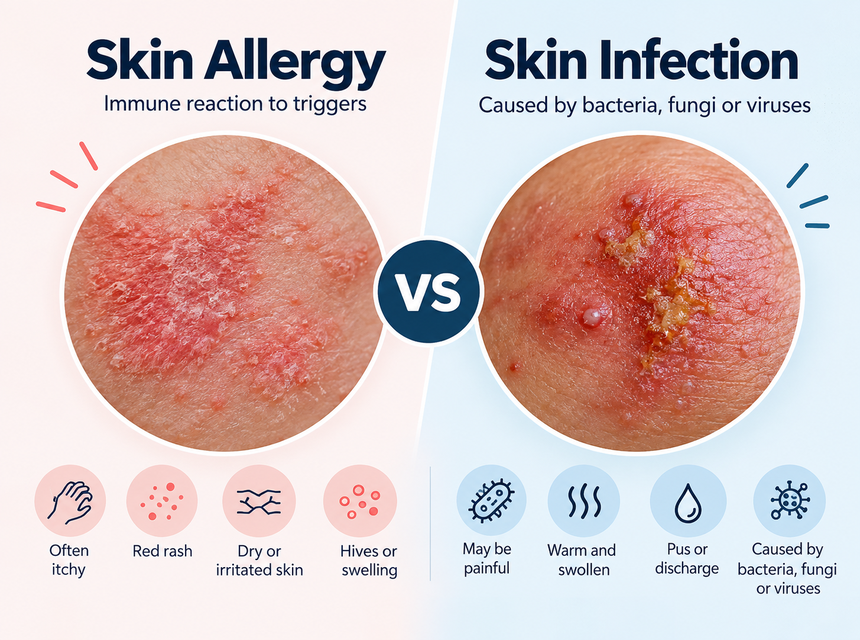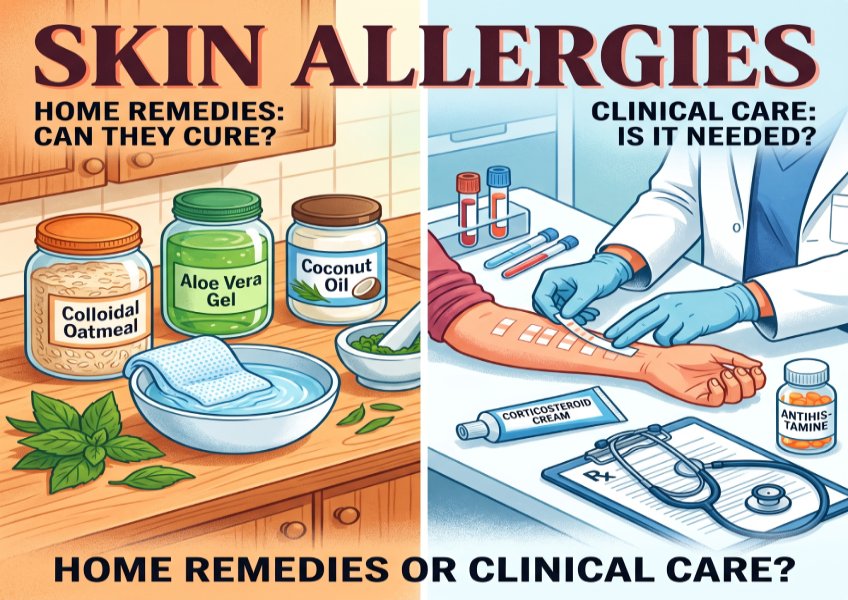
An itchy rash, redness, swelling, or irritated skin can be uncomfortable and frustrating. When symptoms are mild, many people first look for ways to manage them at home. Cool compresses, moisturizers, and avoiding products that may be irritating the skin can sometimes provide temporary relief.
But there is an important distinction between relieving skin allergy symptoms and treating the underlying cause.
Some mild skin reactions may improve after avoiding the trigger and taking appropriate care of the skin. Other rashes may persist, repeatedly return, become infected, or turn out not to be an allergy at all. Conditions such as eczema, fungal infections, and other skin disorders can sometimes cause similar symptoms.
So, can home remedies cure skin allergies, or is medical treatment necessary?
The answer depends on the cause, severity, and duration of the skin reaction.
Can Skin Allergies Be Treated at Home?
For a mild and localized skin reaction, appropriate home care may help reduce itching and irritation while the skin recovers.
For example, if a new skincare product causes a mild rash, stopping that product may allow the reaction to settle. Similarly, protecting irritated skin from further exposure and keeping it moisturized may improve discomfort.
However, home care generally focuses on symptom relief and trigger avoidance. It does not necessarily identify why the reaction occurred or prevent it from returning.
Contact dermatitis is one example. It develops when the skin reacts to an irritant or allergen that comes into contact with it. Identifying and avoiding the responsible substance is an important part of management.
If you are experiencing persistent itching, recurrent rashes, hives, or suspected allergic skin reactions, professional assessment may be necessary to determine the actual cause.
Home Remedies That May Help Mild Skin Irritation
Not every home remedy found online is safe or useful for an allergic skin reaction. Some popular ingredients can actually irritate already-sensitive skin.
For mild symptoms, simpler skin-care measures are generally more appropriate.
1. Apply a Cool Compress
A clean, cool, damp cloth can temporarily reduce itching and discomfort.
The American Academy of Dermatology recommends applying a cool, damp compress to itchy skin for around 10–15 minutes when appropriate.
Avoid applying ice directly to the skin.
2. Use a Fragrance-Free Moisturizer
A fragrance-free cream or ointment can help reduce dryness and support the skin barrier.
Thick creams and ointments are generally preferable to lightweight lotions for very dry or irritated skin. Applying moisturizer after bathing, while the skin is still slightly damp, can help retain moisture.
Look for products labeled fragrance-free rather than assuming that “natural,” “herbal,” or “unscented” automatically means gentle.
3. Avoid the Suspected Trigger
If you suspect that a particular cosmetic, soap, detergent, fragrance, jewelry, or other product is causing the reaction, stopping exposure may help.
However, identifying the trigger is not always straightforward. A reaction may not appear immediately after exposure, and the responsible substance may be something that has been used for a long time.
The American Academy of Dermatology notes that identifying the cause of contact dermatitis can sometimes require careful investigation and, in some cases, patch testing.
4. Keep Showers Short and Lukewarm
Very hot water can worsen dryness and irritation.
If your skin is already sensitive or inflamed, use lukewarm water, avoid harsh cleansers, and apply a suitable moisturizer afterward. These measures can be particularly useful for eczema-prone skin.
5. Try Not to Scratch
Scratching may provide temporary relief but can further damage irritated skin.
Repeated scratching can create breaks in the skin and increase the risk of secondary infection. Keeping fingernails short and using a cool compress when itching becomes intense may help reduce the urge to scratch.
What Home Remedies Cannot Do
This is where people often misunderstand the role of home treatment.
Home care may reduce symptoms, but it does not necessarily answer important questions such as:
- What caused the rash?
- Is it actually an allergy?
- Is the trigger still present?
- Is the condition eczema or dermatitis?
- Could it be a fungal infection?
- Has the rash become infected?
- Why does the problem keep coming back?
- Does the condition require prescription treatment?
For example, an itchy, scaly rash may be caused by a fungal infection rather than an allergy. Using home remedies without knowing the cause may delay appropriate treatment.
Similarly, eczema and dermatitis can cause chronic itching, dryness, redness, and irritation and may require a structured treatment plan rather than occasional home remedies. See our Eczema and Dermatitis Treatment in Sylhet page for more information.
When Should You See a Dermatologist for a Skin Allergy?
A mild rash that is improving after removing a suspected trigger may not require immediate medical attention.
However, you should consider seeing a dermatologist if the symptoms are persistent, severe, recurrent, spreading, or difficult to explain.
Professional evaluation is particularly important if:
- The rash keeps coming back.
- The itching is severe or interferes with sleep.
- The rash is spreading or becoming more extensive.
- The skin becomes painful or very tender.
- The affected area becomes unusually warm or swollen.
- You notice pus, significant discharge, or yellow crusting.
- The rash does not improve with appropriate basic skin care.
- You cannot identify what is triggering the reaction.
- The rash is affecting your daily activities.
- You are unsure whether the problem is an allergy, eczema, fungal infection, or another skin condition.
Your skin allergy treatment in Sylhet options may depend on the cause, severity, duration, and pattern of your symptoms.
Can Scratching a Skin Allergy Cause an Infection?
Yes.
An itchy allergic or inflammatory rash can create a strong urge to scratch. Repeated scratching can damage the skin and create small openings through which microorganisms can enter.
This can lead to a secondary skin infection.
Warning signs may include increasing pain, warmth, swelling, pus, yellow crusting, or a noticeable worsening of the affected area.
This is one reason it is important not to assume that a worsening rash is simply a more severe allergy.
If you notice signs that suggest infection, a dermatologist can assess whether the problem is still primarily an allergic or inflammatory condition or whether an infection has developed as well.
Can a Skin Allergy Go Away Without Treatment?
Sometimes, yes.
Some mild reactions improve after the responsible irritant or allergen is removed. For example, contact dermatitis may settle when exposure to the substance causing the reaction is stopped.
But this does not mean every skin allergy will disappear on its own.
Some conditions are recurrent or chronic. Eczema, for example, can improve with appropriate management but may flare again over time.
If the same rash repeatedly returns, simply treating the symptoms each time may not address the underlying problem.
The more useful question is often:
What is causing the reaction, and how can future flare-ups be prevented?
That may require a proper medical assessment.
What Does Clinical Care Offer?
The main advantage of clinical care is not simply access to stronger medication. It is the ability to identify the likely cause and choose treatment accordingly.
A dermatologist may assess:
- The appearance and distribution of the rash
- When the symptoms started
- Previous episodes
- Skincare and cosmetic products
- Soaps and detergents
- Medications
- Environmental exposures
- Possible allergens or irritants
- Symptoms suggesting infection or another skin condition
If contact dermatitis is suspected and the trigger is difficult to identify, patch testing may sometimes be recommended to help identify specific allergens.
Treatment then depends on the diagnosis. Depending on the condition, a dermatologist may recommend appropriate topical treatments, medicines, trigger avoidance, skin-care measures, or further investigation.
The goal is not simply to stop the itching temporarily. It is to manage the underlying condition and reduce the likelihood of repeated flare-ups.
Home Care and Medical Treatment Can Work Together
It does not have to be a choice between home care and professional treatment.
For many skin conditions, appropriate daily skin care remains useful even when medical treatment is needed.
For example, a treatment plan may include:
- Avoiding known triggers
- Using fragrance-free moisturizers
- Taking short, lukewarm showers
- Avoiding unnecessary scratching
- Protecting irritated skin
- Using prescribed medication when appropriate
- Following up if symptoms persist or return
The important distinction is that home care should support appropriate treatment rather than replace medical assessment when assessment is needed.
When Is a Skin Reaction an Emergency?
Some allergic reactions can become medical emergencies.
If a skin reaction is accompanied by swelling of the lips, tongue, mouth, or throat, difficulty breathing, severe dizziness, fainting, or other signs of a severe allergic reaction, seek emergency medical care immediately.
Do not rely on home remedies for symptoms that may indicate a serious systemic allergic reaction.
Frequently Asked Questions
Can home remedies cure skin allergies permanently?
Usually, home remedies should be viewed as measures that may relieve symptoms or protect irritated skin rather than as a permanent cure. Some mild reactions may resolve after the trigger is removed, while recurrent or chronic conditions may require medical evaluation and ongoing management.
Is aloe vera good for skin allergies?
Aloe vera is commonly used for irritated skin, but “natural” does not automatically mean that a product is suitable for an allergic rash. Some people may react to topical products or their ingredients. For sensitive or inflamed skin, simpler fragrance-free moisturizers and appropriate medical advice may be preferable.
Is coconut oil good for skin allergies?
Coconut oil may act as a moisturizer for some people, but it is not a treatment for the underlying cause of a skin allergy. If the skin reaction is caused by an allergen or another skin condition, relying on coconut oil alone may delay appropriate diagnosis and treatment.
Should I use home remedies for an itchy rash?
For mild irritation, simple measures such as a cool compress, avoiding suspected triggers, and using a fragrance-free moisturizer may provide relief. However, persistent, recurrent, spreading, painful, or worsening rashes should be evaluated rather than treated indefinitely at home.
How long should I wait before seeing a dermatologist?
There is no single number of days that applies to every rash. If symptoms are severe, rapidly worsening, recurrent, or affecting your daily life, seek medical advice sooner. If the cause is unclear or the rash is not improving with appropriate basic care, a dermatologist can help determine the cause.
Can a skin allergy turn into a skin infection?
The allergic reaction itself does not simply “turn into” an infection, but scratching can damage the skin and make a secondary infection more likely. Increasing pain, warmth, swelling, pus, or crusting can be warning signs that an infection may have developed.
Conclusion
Home care can be useful for mild skin irritation and some allergic skin reactions, particularly when it involves avoiding a suspected trigger, keeping the skin moisturized, using cool compresses, and avoiding scratching.
But home remedies have limits.
If a rash is persistent, recurrent, severe, spreading, or difficult to identify, the priority should be finding the underlying cause rather than repeatedly trying different home treatments. Conditions such as contact dermatitis, eczema, fungal infections, and other skin disorders can have overlapping symptoms but require different approaches.
If you have persistent itching, recurrent rashes, hives, or suspected skin allergies, professional evaluation can help determine the likely cause and appropriate treatment.
For patients seeking skin allergy treatment in Sylhet, Dr. MD Zakaria provides dermatological consultation and treatment based on the individual patient’s symptoms and condition.
Learn more about Skin Allergy Treatment in Sylhet →
Sources & Further Reading
CDC — Ringworm: Signs and Symptoms
American Academy of Dermatology — Contact Dermatitis
Mayo Clinic — Contact Dermatitis

Dr. Md. Zakaria is a top Dermatologist and medical professional based in Sylhet, Bangladesh. With extensive clinical experience in skin disease and venereology, he specializes in the diagnosis, treatment, and long-term management of complex skin, hair, and nail disorders, alongside advanced aesthetic dermatological care.